
How to Read an Acetate Tow Certificate: 9 Properties Explained
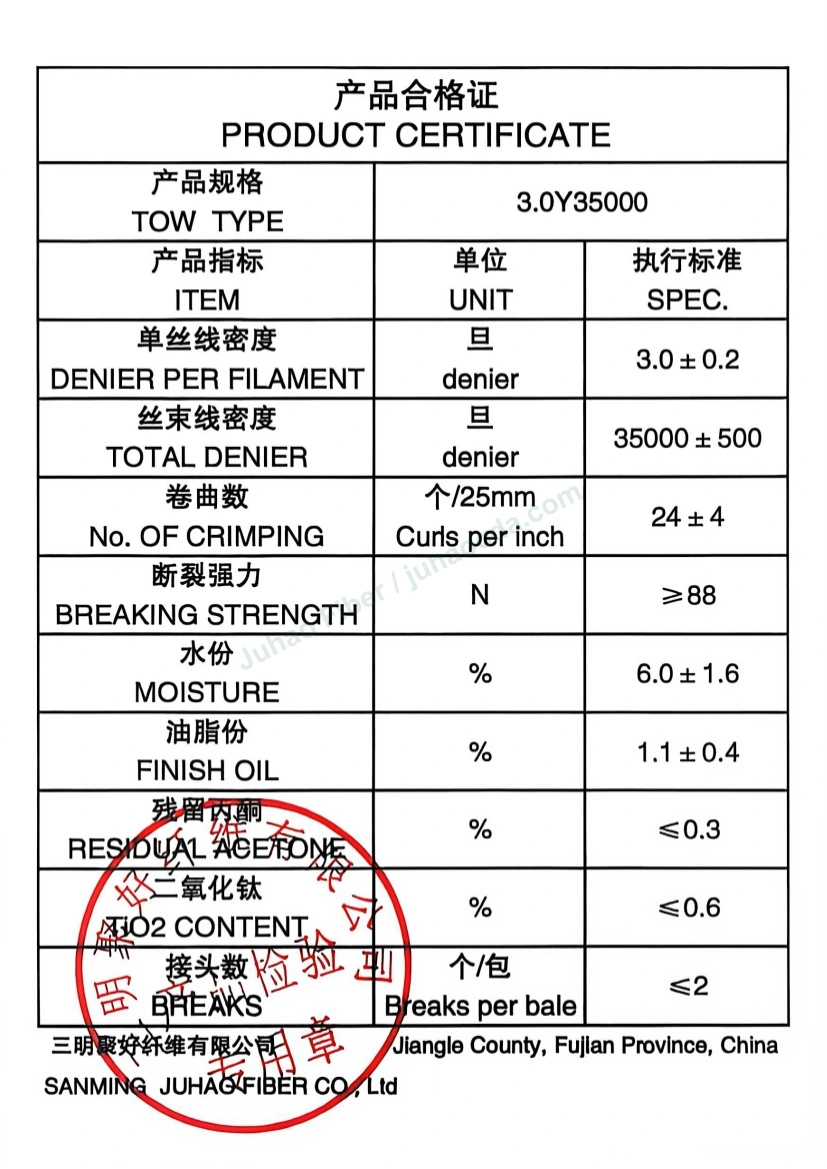
Every shipment of cellulose acetate tow should come with a product certificate. It is a short table, but each line tells a filter rod maker something specific: whether the tow will run at the right rod weight, open evenly on the machine, and stay consistent from bale to bale.
This guide walks through each property on a typical acetate tow certificate, using the specifications printed on Juhao Fiber’s own certificates as examples.
The certificate at a glance
Here is the specification for our 3.0Y-35000D item:
| Property | Unit | Specification |
|---|---|---|
| Denier per filament | denier | 3.0 ± 0.2 |
| Total denier | denier | 35,000 ± 500 |
| Number of crimps | crimps per 25 mm | 24 ± 4 |
| Breaking strength | N | ≥ 88 |
| Moisture | % | 6.0 ± 1.6 |
| Finish oil | % | 1.1 ± 0.4 |
| Residual acetone | % | ≤ 0.3 |
| TiO₂ content | % | ≤ 0.6 |
| Breaks (joints) | per bale | ≤ 2 |
The first two lines identify the item. The rest describe how the tow will behave in production.
1. Denier per filament
Denier per filament (dpf) is the weight in grams of 9,000 meters of a single filament. It sets how fine the fibers are, and fineness drives pressure drop: for the same rod size and weight, finer filaments create more resistance to airflow.
A tolerance of ± 0.2 denier keeps the filament size, and therefore the pressure drop, within a narrow window. If dpf drifts, filter makers have to change rod weight to keep pressure drop on target.
2. Total denier
Total denier is the weight in grams of 9,000 meters of the whole tow band. It tells you how much fiber goes into each meter of filter rod, so it largely sets the rod weight range an item can reach.
A tolerance of ± 500 denier on a 35,000 denier band is about ± 1.4%. Tight control here means fewer adjustments on the rod maker when switching from one bale to the next.
3. Number of crimps
Crimp is the zigzag wave put into the filaments after spinning. It is counted as crimps per 25 mm, which is close to one inch, so the same value is often written as crimps per inch.
Crimp gives the tow bulk and helps it open into an even web on the filter rod machine. Too little crimp and the tow packs flat and opens poorly. Too much and the band can be hard to open evenly. Our certificates specify 24 ± 4 crimps per 25 mm across all 10 items.
4. Breaking strength
Breaking strength is the force, in newtons, needed to break the tow band. The band is pulled continuously out of the bale and through the opening rollers, so it needs enough strength to run without snapping.
Breaking strength depends mainly on how much fiber is in the band, so it is specified per item. On our certificates it ranges from ≥ 30 N for 8.0Y-15000D to ≥ 88 N for 2.5Y-35000D and 3.0Y-35000D:
| Item | Breaking strength |
|---|---|
| 2.5Y-30000D | ≥ 75 N |
| 2.5Y-35000D | ≥ 88 N |
| 3.0Y-30000D | ≥ 75 N |
| 3.0Y-32000D | ≥ 80 N |
| 3.0Y-35000D | ≥ 88 N |
| 4.8Y-22000D | ≥ 55 N |
| 5.0Y-25000D | ≥ 60 N |
| 5.0Y-30000D | ≥ 75 N |
| 6.0Y-17000D | ≥ 35 N |
| 8.0Y-15000D | ≥ 30 N |
5. Moisture
Cellulose acetate absorbs some moisture from the air. Moisture affects the weight of the tow and how it behaves during opening and plasticizer application. Our specification is 6.0 ± 1.6%.
Because moisture is part of the weight, a bale that is unusually wet or dry will change rod weight even if the fiber itself is the same. Store bales in a dry, covered area and keep them in their packaging until use.
6. Finish oil
Finish oil is a thin surface coating applied during production. It reduces friction and static so the tow runs smoothly over rollers and opens cleanly. Our specification is 1.1 ± 0.4%.
7. Residual acetone
Acetate tow is spun from a solution of cellulose acetate in acetone. Most of the acetone evaporates during spinning and is recovered, but a trace can remain in the fiber. The certificate sets an upper limit. Ours is ≤ 0.3%.
8. TiO₂ content
Titanium dioxide is added as a delustrant, which gives the tow its matte white look. The certificate sets an upper limit. Ours is ≤ 0.6%.
9. Breaks per bale
This line counts the joints in a bale, the points where the tow band is not one continuous piece. Each joint can interrupt the filter rod machine, so fewer joints mean less downtime. Our certificates allow no more than 2 per bale.
What the certificate does not tell you
A certificate shows that a batch met its specification. It does not show how the tow will perform on your rod design. For that, ask the supplier for a capability curve for the item on your rod circumference and length, and run samples on your own machines. Our guide What Is Cellulose Acetate Tow? explains how the specification relates to pressure drop.
It is also worth comparing several certificates over time. Values that stay near the center of the tolerance from batch to batch are a better sign of process control than a single good result.
Our certificates
Certificates for all 10 Juhao Fiber tow items, from 2.5Y to 8.0Y, are available on our product pages.
To request samples or discuss which item fits your filter, contact us at sales@juhaocda.com.
